


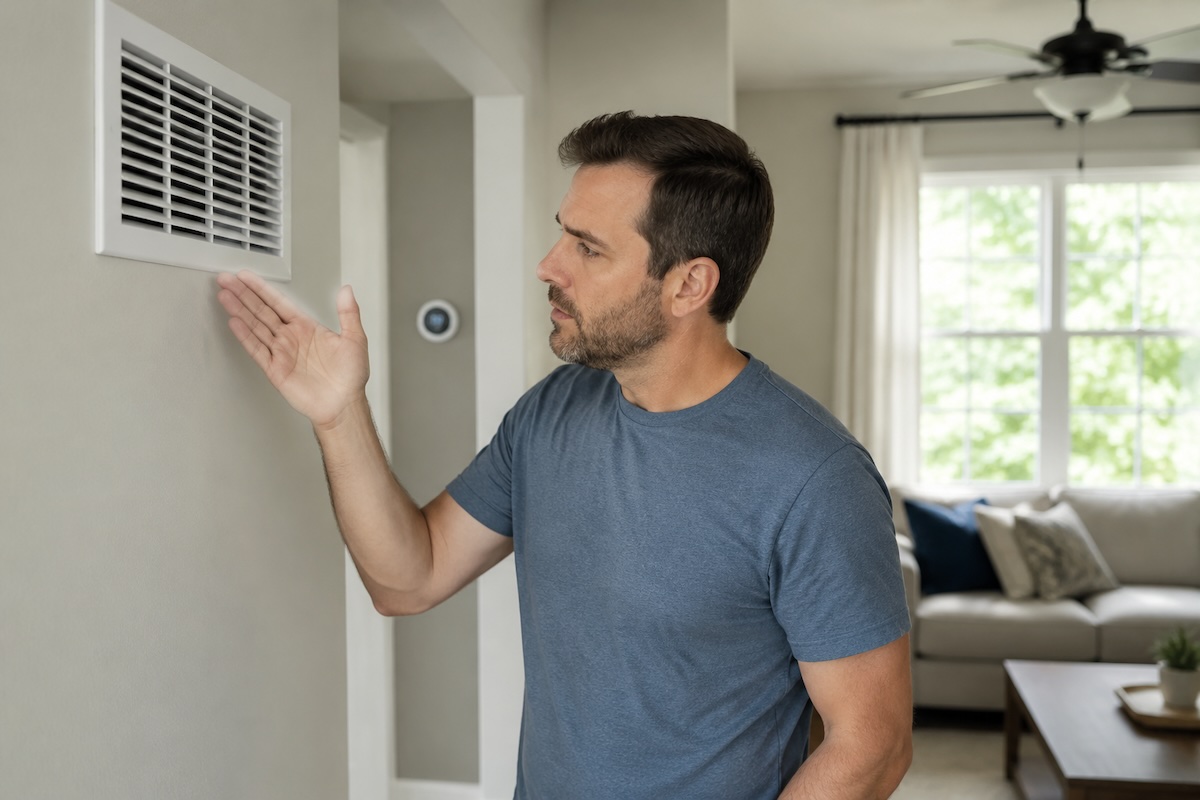
Your air conditioner is running, but the air coming from the vents feels warm or barely cool. In some cases, the AC may run for hours without reaching the temperature on the thermostat.
The cause could be simple, such as a dirty filter or incorrect thermostat setting. It could also involve a frozen coil, refrigerant leak, electrical issue, or failed component.
Before you call an HVAC technician, check a few basic things first.
AC Running but Not Cooling? Start Here
Try these quick checks:
- Set the thermostat to Cool.
- Set the fan to Auto.
- Lower the thermostat a few degrees below the room temperature.
- Check the air filter.
- Make sure supply and return vents are open.
- Check whether the outdoor unit is running.
- Look for visible ice on refrigerant lines or the indoor unit.
- Check the electrical panel for a tripped breaker.
- Clear leaves and debris from around the outdoor unit.
If your AC still does not cool after these checks, the system likely needs professional service.
Suggested Dan Wood Services team quote for internal approval:
“We always recommend starting with the simple things first. Check the thermostat, filter, vents, and outdoor unit. If those look normal and the house still isn’t cooling, that’s when it makes sense to have the system properly diagnosed.”
1. Check the Thermostat
Start with the thermostat.
Make sure you set the system to Cool and choose a temperature below the current room temperature.
Also check the fan setting.
If you set the fan to On, the blower keeps moving air even when the AC is not actively cooling. That can make the air from the vents feel warm.
For normal operation, set the fan to Auto.
Other thermostat problems can include:
- Weak batteries
- A programmed schedule changing the setting
- Incorrect temperature settings
- A thermostat malfunction
- Someone accidentally changing the mode
What to Do
Set the thermostat to Cool, switch the fan to Auto, and lower the temperature by a few degrees.
Wait several minutes.
If the outdoor unit starts and the air becomes cooler, the thermostat setting may have caused the problem.
2. Check the Air Filter
A dirty air filter can reduce airflow through your HVAC system.
When airflow drops, your AC works harder and may struggle to cool your home. Severe airflow restriction can also cause the evaporator coil to freeze.
Watch for these signs:
- Weak airflow from vents
- Longer cooling cycles
- Uneven room temperatures
- More dust inside the home
- AC running without reaching the thermostat setting
What to Do
Remove the filter and inspect it.
Replace it if it looks heavily coated with dust or debris. Use the correct filter size and type for your system.
How often you need to replace the filter depends on your home, pets, filter type, indoor air quality, and system use.
Instead of following one fixed schedule, check the filter regularly.
3. Check for Blocked Vents
Your AC may cool the air properly but struggle to move it through the house.
Check your supply registers and return vents.
Look for:
- Furniture blocking vents
- Rugs covering floor registers
- Curtains hanging over vents
- Closed registers
- Boxes or other items blocking return vents
Keep both supply and return vents clear.
Avoid closing several vents in unused rooms. Your HVAC system depends on balanced airflow, and closing too many vents can interfere with normal operation.
4. Inspect the Outdoor AC Unit
The outdoor condenser releases heat from your home.
Because it sits outside, leaves and debris can block airflow around it.
Common obstructions include:
- Leaves
- Grass clippings
- Dirt
- Weeds
- Cottonwood
- Shrubs
- Yard debris
Restricted airflow can reduce cooling performance, especially during hot weather.
What to Do
Turn the system off before clearing debris around the condenser.
Remove loose leaves, weeds, and vegetation from the area.
Do not remove access panels or touch electrical components inside the unit.
If the condenser coil looks heavily clogged or damaged, schedule professional service.
5. Look for a Frozen Evaporator Coil
An air conditioner can freeze even during hot weather.
The evaporator coil absorbs heat from indoor air. If the system loses proper airflow or develops another problem, moisture on the coil can freeze.
Common causes include:
- A dirty air filter
- Restricted airflow
- A dirty evaporator coil
- Blower problems
- Refrigerant issues
Signs of a Frozen AC
Look for:
- Ice on refrigerant lines
- Ice around the indoor unit
- Very weak airflow
- Warm air from vents
- AC running continuously
- Water around the indoor unit after the ice melts
What to Do
Turn off cooling if you see ice.
Check the air filter and replace it if necessary.
Do not keep running the system while it is frozen.
If the AC freezes again, call an HVAC technician. Repeated freezing usually points to an underlying problem.
6. Your AC May Be Low on Refrigerant
Refrigerant helps your air conditioner move heat out of your home.
A properly working system should not simply “use up” refrigerant. If the level is low, the system may have a leak or another mechanical problem.
Possible signs include:
- Lukewarm air from vents
- Poor cooling during hot weather
- Long cooling cycles
- Ice on refrigerant lines
- Hissing or bubbling sounds
- Difficulty reaching the thermostat setting
Leave Refrigerant Work to a Professional
Do not try to recharge the system yourself.
A technician needs to inspect the system, identify the cause, and determine whether a leak is present.
Adding refrigerant without fixing the underlying issue may only create a temporary solution.
7. Check the Circuit Breaker
Your central AC relies on several electrical components.
Sometimes the indoor blower continues running while the outdoor unit loses power. When that happens, you may feel air from the vents without actual cooling.
Check your electrical panel for a tripped AC breaker.
What to Do
You can reset the breaker once.
If it trips again, leave it off and call an HVAC professional.
Repeated breaker trips can point to:
- Wiring problems
- Electrical shorts
- Motor issues
- Compressor problems
- Failing electrical components
Do not keep resetting the breaker.
8. Check Whether the Outdoor Unit Is Running
If air comes from the vents but does not feel cold, check the outdoor unit.
If the indoor blower runs while the condenser stays silent, the system may have an electrical or mechanical problem.
Possible causes include:
- Failed capacitor
- Contactor problem
- Wiring issue
- Fan motor failure
- Control problem
- Compressor failure
You can check whether the unit is running, but do not open the cabinet or touch electrical components.
Some parts can retain a dangerous electrical charge even after you turn off the system.
9. The Blower May Not Be Moving Enough Air
The blower moves conditioned air through your ductwork and into your rooms.
If it does not work properly, your AC may cool the air but fail to distribute it effectively.
Signs of a blower problem include:
- Weak airflow
- Little or no air from certain vents
- Airflow that starts and stops
- Unusual noises from the indoor unit
- Uneven temperatures between rooms
If you replace a dirty filter and clear blocked vents but airflow remains weak, schedule an inspection.
10. Your Ductwork May Be Leaking
Your AC may work properly while cooled air escapes through damaged ductwork.
Duct problems can include:
- Loose connections
- Cracks
- Gaps
- Damaged sections
- Poorly sealed joints
- Airflow restrictions
Leaks can cause bigger problems when ducts run through attics, crawlspaces, basements, or other unconditioned spaces.
Signs of Duct Problems
You may notice:
- One room stays much warmer than another
- Weak airflow from certain vents
- Long cooling cycles
- Uneven temperatures
- Higher energy use
Some duct problems remain hidden behind walls, ceilings, or insulation.
An HVAC technician can determine whether the equipment, ductwork, or both are causing the problem.
11. The Compressor May Be Failing
The compressor helps circulate refrigerant through the cooling system.
If it starts to fail, your AC may run without cooling the house properly.
Possible signs include:
- Warm air from vents
- Strange noises from the outdoor unit
- Difficulty starting
- Repeated breaker trips
- Frequent on-and-off cycling
A compressor problem requires professional diagnosis.
It also does not automatically mean you need a new AC. A technician should consider the repair cost, system condition, parts availability, and overall performance before recommending replacement.
12. Your AC May Be the Wrong Size
If your AC has always struggled to cool the home, system sizing may be part of the problem.
An undersized AC may run for long periods without reaching the thermostat setting.
However, a bigger system is not always better.
An oversized AC can cool the house too quickly, cycle frequently, and struggle to control indoor humidity.
A properly sized system should account for more than square footage. Factors such as insulation, windows, layout, air leakage, and sun exposure also affect the cooling load.
Should You Turn Off an AC That Is Blowing Warm Air?
You do not need to shut down the system every time you feel warm air.
However, turn the AC off and schedule service if you notice:
- Ice on the system
- A breaker that keeps tripping
- A burning smell
- Electrical problems
- Grinding or severe mechanical noises
- Water near electrical components
- An outdoor unit that repeatedly tries and fails to start
Running the system with a serious mechanical or electrical problem can cause more damage.
Suggested Dan Wood Services team quote for internal approval:
“If you see ice, smell something burning, or have a breaker that keeps tripping, don’t keep forcing the AC to run. Shut it down and let a technician find the cause before a smaller problem becomes a larger repair.”
When Should You Call an HVAC Technician?
If you already checked the thermostat, filter, vents, breaker, and outdoor unit but the AC still does not cool, schedule service.
Call an HVAC technician if:
- The AC keeps blowing warm air
- The outdoor unit will not start
- The evaporator coil freezes repeatedly
- Airflow remains weak
- You suspect a refrigerant leak
- The breaker repeatedly trips
- You hear buzzing, grinding, or other unusual noises
- The AC runs continuously without cooling the home
- Cooling performance suddenly drops
A trained technician should handle refrigerant, electrical, motor, compressor, and internal control problems.
Should You Repair or Replace Your AC?
A cooling problem does not automatically mean you need a new system.
Repair May Make Sense When:
- The problem is minor
- The system has been reliable
- The repair cost is reasonable
- Replacement parts are available
- The AC still cools the home well when it works properly
Replacement May Make Sense When:
- Repairs are becoming frequent
- Several components are wearing out
- The AC regularly struggles to cool the home
- A major component has failed
- Energy use has increased
- Repair costs are becoming difficult to justify
Do not base the decision on age alone.
A good HVAC technician should explain what failed, how much the repair will cost, the overall condition of the system, and what you can expect after the repair.
That gives you enough information to make an informed decision.
Can Regular AC Maintenance Prevent Cooling Problems?
Routine maintenance cannot prevent every breakdown, but it can help catch problems early.
During professional maintenance, a technician may inspect:
- Electrical connections
- System controls
- Indoor and outdoor coils
- Refrigerant performance
- Airflow
- Blower operation
- Condensate drainage
- Thermostat operation
- Overall system condition
Homeowners can also help by keeping the outdoor unit clear and checking the air filter regularly.
These simple steps support proper airflow and help your system operate more efficiently.
AC Not Blowing Cold Air in Novi or Metro Detroit? We’re Here to Help
If you checked the thermostat, filter, vents, and outdoor unit but your AC still does not cool, you do not need to keep troubleshooting on your own.
At Dan Wood Plumbing, Heating, Cooling & Electrical, we help homeowners in Novi and across Metro Detroit diagnose and repair air conditioning problems.
Our team works on all makes and models and can help with:
- AC repair
- Cooling system diagnostics
- AC maintenance
- Airflow problems
- AC installation and replacement
- Emergency cooling service
As a third-generation local company, we focus on identifying the actual problem and explaining your options clearly.
Sometimes the answer is a straightforward repair. In other cases, we may recommend comparing repair and replacement based on the condition of the system.
Either way, we want you to understand what is happening before you make a decision.
If your air conditioner is blowing warm air, freezing up, running constantly, or struggling to keep your home comfortable, contact Dan Wood Services to schedule AC service in Novi or the Metro Detroit area.
Frequently Asked Questions
Why is my AC running but not blowing cold air?
Common causes include an incorrect thermostat setting, dirty filter, restricted airflow, frozen coil, refrigerant problem, electrical issue, or a condenser that is not running.
Start with the thermostat, filter, vents, breaker, and outdoor unit. If those look normal, schedule professional service.
Can a dirty air filter cause my AC to blow warm air?
Yes. A clogged filter restricts airflow and can reduce cooling performance. In severe cases, it can also contribute to a frozen evaporator coil.
Why did my AC suddenly stop cooling?
A sudden loss of cooling can result from a tripped breaker, thermostat issue, frozen coil, electrical failure, refrigerant problem, or outdoor-unit malfunction.
If basic checks do not reveal the cause, call an HVAC technician.
How do I know if my AC is low on refrigerant?
Possible signs include weak cooling, long run times, ice on refrigerant lines, and hissing or bubbling sounds.
These symptoms can have other causes, so a technician should test the system before confirming a refrigerant problem.
Should I turn off my AC if the coil freezes?
Yes.
Turn off the cooling and let the system thaw. Check the air filter for an obvious airflow restriction.
If the system freezes again, schedule service.
Why won’t my AC cool below 75 degrees?
Possible causes include restricted airflow, dirty coils, leaking ducts, refrigerant problems, equipment issues, high cooling demand, or an improperly sized AC.
If this happens regularly, have the system inspected.
How do I know if I should repair or replace my AC?
Look at the overall condition of the system.
A minor problem in an otherwise reliable AC may be worth repairing. If the system needs frequent repairs, has major component problems, or no longer keeps the home comfortable, compare repair and replacement options with an HVAC professional.