

Quick Answer: How Much Does Furnace Replacement Cost in Michigan?
Furnace replacement in Michigan typically costs $5,000–$10,000, including equipment and professional installation. Basic gas furnace replacements may cost less, while premium systems or installations requiring additional work can exceed $12,000.
The final price depends on furnace size, efficiency, labor, venting, and ductwork.
These are estimated market prices, not fixed quotes from Dan Wood Services.
Replacing your furnace is a significant expense, especially when your home depends on reliable heating during Michigan winters.
Whether your current system is nearing the end of its lifespan or needs frequent repairs, understanding replacement costs can help you make an informed decision.
At Dan Wood Plumbing, Heating, Cooling & Electrical, we’ve served Novi and Metro Detroit homeowners since 1957. Here’s what affects furnace replacement costs and how to choose the right system for your home.
How Much Does a New Furnace Cost in Michigan?
A new furnace in Michigan generally costs between $5,000 and $10,000 when professionally installed. Prices vary depending on equipment efficiency, heating capacity, and installation requirements.
For example, replacing an existing gas furnace with a similar system may cost less than upgrading to a high-efficiency model that requires new venting or drainage connections.
Estimated Furnace Replacement Costs in Michigan
| Furnace Replacement Type | Estimated Installed Cost |
|---|---|
| Basic gas furnace replacement | $3,500–$5,500 |
| Standard gas furnace installation | $5,000–$8,000 |
| High-efficiency gas furnace | $6,000–$10,000 |
| Premium or complex installation | $9,000–$12,000+ |
These are approximate budgeting ranges based on published Michigan market estimates. They are not Dan Wood Services quotes or verified statewide averages for each furnace category. Costs overlap depending on equipment and installation requirements.
For context, Modernize estimates Michigan furnace replacement costs at $5,800–$10,200 installed. Other Michigan cost guides report different ranges, reflecting differences in project scope, equipment, and pricing methods.
The most useful number is the total installed price, including equipment, labor, and any necessary modifications.
What Affects Furnace Replacement Costs?
Five factors have the greatest influence on your final furnace replacement price.
1. Furnace Size and Heating Capacity
Furnace size refers to its heating capacity, measured in British Thermal Units (BTUs) per hour.
Larger homes often require more heating capacity, but square footage isn’t the only consideration.
Insulation, windows, ceiling height, air leakage, and home layout all affect heating needs.
A furnace that’s too small may struggle during cold weather. An oversized furnace may cycle too frequently, reducing comfort and potentially increasing wear.
A professional heating-load calculation helps determine the appropriate furnace capacity.
2. Furnace Efficiency (AFUE)
Furnace efficiency is measured using Annual Fuel Utilization Efficiency (AFUE). The rating indicates how much fuel energy becomes useful heat over a typical year.
| AFUE Rating | What It Means |
|---|---|
| 80% | Approximately 80% of fuel energy becomes useful heat |
| 95% | Approximately 95% becomes useful heat |
| 98% | Approximately 98% becomes useful heat |
Higher-efficiency furnaces generally cost more upfront but require less fuel to produce the same amount of heat.
For Michigan homeowners with older, less efficient systems, upgrading may reduce heating expenses over time.
However, actual savings depend on natural gas prices, home insulation, and heating habits.
3. Furnace Type and Features
Furnaces have different operating features that affect their cost and comfort.
Single-stage furnaces operate at one heating output level. They’re generally the simplest and most affordable option.
Two-stage furnaces use two heating levels, allowing them to operate at lower output when less heat is needed.
Modulating furnaces adjust heating output in smaller increments to maintain more consistent indoor temperatures.
Variable-speed blowers are another feature that can improve airflow and comfort.
More advanced equipment usually costs more, but the right choice depends on your home’s heating needs and budget.
4. Installation Labor
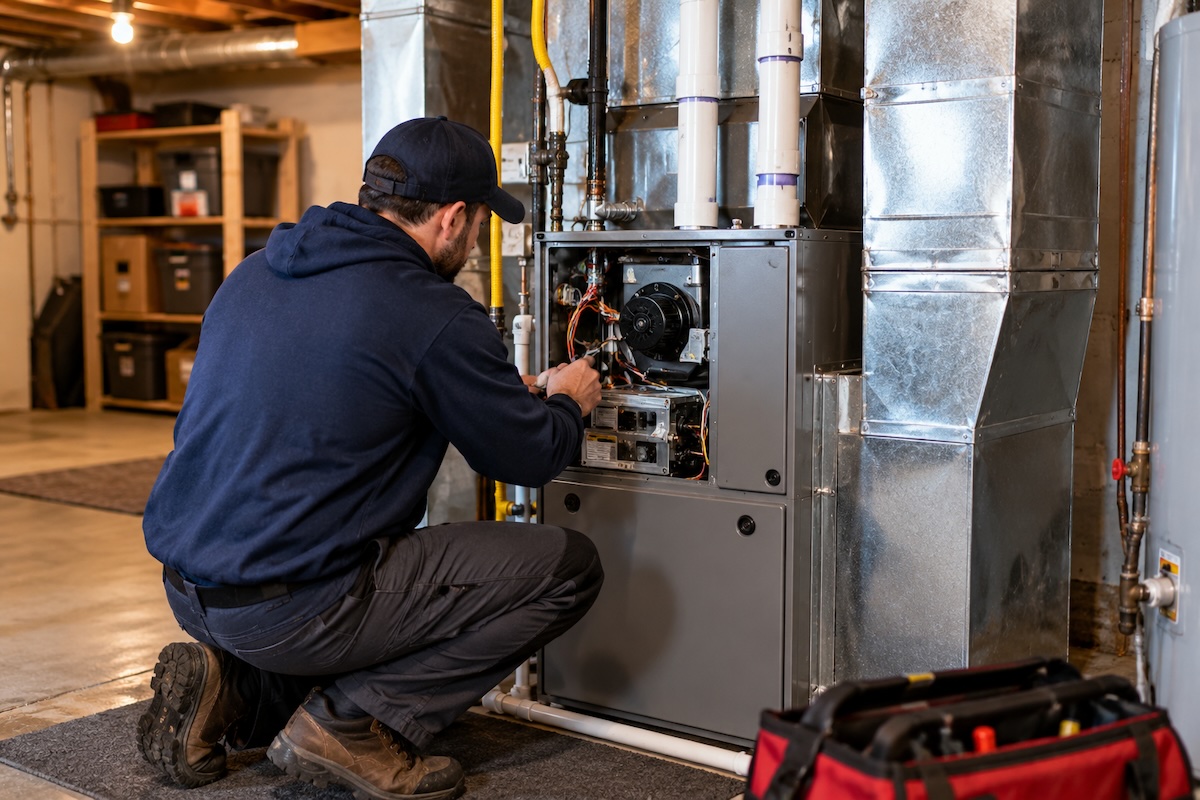
Labor costs depend on how much work is required to remove the existing furnace and install the replacement.
A straightforward installation may use the existing system connections.
More complicated projects may require gas piping, electrical, venting, or drainage modifications.
5. Existing Ductwork
Your new furnace must work with your home’s duct system.
If the ducts are damaged, improperly sized, or restricting airflow, repairs or modifications may be needed.
Not every furnace replacement requires new ductwork. A heating professional can inspect the existing system and determine whether changes are necessary.
What Can Increase Your Final Furnace Replacement Cost?
Unexpected installation expenses are a common concern for homeowners comparing furnace quotes.
Several conditions can increase the final price beyond the cost of the equipment and basic installation.
Switching to a High-Efficiency Furnace
High-efficiency condensing gas furnaces typically require suitable exhaust venting and condensate drainage.
If your existing furnace uses a different venting arrangement, additional installation work may be necessary.
Repairing or Modifying Ductwork
Damaged or undersized ducts may need modifications to provide proper airflow.
These changes can increase installation costs, particularly when ductwork is difficult to access.
Relocating the Furnace
Moving a furnace to another area of the home may require additional gas piping, electrical connections, venting, and ductwork.
Keeping the new furnace in the existing location is often less expensive when that location remains suitable.
Updating Existing Connections
Older homes may need changes to gas, electrical, or ventilation components to accommodate new equipment and meet applicable requirements.
These issues are best identified before installation.
How to avoid surprises: Ask your contractor to inspect the existing furnace, venting, connections, and ductwork before providing a final estimate.
What Should Be Included in a Furnace Replacement Quote?
A furnace replacement estimate should clearly explain the equipment and installation work being provided.
Before accepting a quote, review these items:
| Item | What to Check |
|---|---|
| Furnace equipment | Brand, model, capacity, and efficiency rating |
| Installation labor | Removal and installation work |
| Old furnace disposal | Whether removal and disposal are included |
| Venting | Required exhaust and intake modifications |
| Gas and electrical connections | Necessary upgrades or changes |
| Ductwork | Required repairs or adjustments |
| Permits and inspections | Applicable local requirements |
| Warranty | Manufacturer and workmanship coverage |
Not every installation requires all these services. Contractors may also include different items in their standard pricing.
A complete, written estimate makes it easier to compare options and understand the total cost.
Need an estimate for your home? At Dan Wood Services, our heating team can assess your existing furnace, discuss suitable replacement options, and explain the work required.
Request a furnace replacement estimate.
Why Can Furnace Replacement Cost More in Michigan?
Michigan’s cold winters make reliable heating especially important.
A furnace must be properly sized to maintain comfortable indoor temperatures during extended periods of cold weather.
However, buying a larger furnace doesn’t necessarily improve heating performance. Equipment sizing should account for your home’s insulation, air leakage, windows, and local winter design temperatures.
Basement Furnace Installations
Many Metro Detroit homes have furnaces installed in basements.
A basement location may offer convenient access to ductwork and utilities, but installation costs can increase if the equipment is difficult to remove or if existing connections need modification.
Older Homes and Ductwork
Some older Michigan homes have heating systems that have been modified over time.
Before installing a replacement furnace, a contractor may need to evaluate duct capacity, airflow, and ventilation.
Permits and Local Requirements
Furnace replacement generally requires a mechanical permit in Michigan.
Specific permitting and inspection procedures depend on the jurisdiction responsible for the property.
Ask your contractor whether the estimate includes required permits and inspections.
Is a High-Efficiency Furnace Worth the Extra Cost?
A high-efficiency furnace may be worth considering if you’re replacing an older, less efficient system.
For example, a 96% AFUE furnace theoretically uses about 16.7% less fuel than an 80% AFUE furnace to deliver the same amount of heat.
If your older furnace uses $1,200 worth of natural gas annually for space heating, a 96% AFUE system could reduce that expense to approximately $1,000 under equivalent conditions.
That represents about $200 in potential annual fuel savings.
This is an illustrative calculation, not a guaranteed result. Actual savings depend on gas prices, weather, heating demand, and the performance of both systems.
A high-efficiency furnace may make sense when:
- Your current furnace is relatively inefficient.
- You plan to remain in your home for several years.
- Your home has substantial heating demand.
- You value improved comfort and temperature control.
The best choice depends on the additional installation cost and your expected long-term savings.
Should You Repair or Replace Your Furnace?
Repairing your furnace is often more economical when the system is relatively new and the problem is minor. Replacement becomes more practical when an older furnace requires frequent repairs or has a major component failure.
Many residential furnaces last approximately 15–20 years, although maintenance, usage, and installation quality affect lifespan.
Furnace Repair vs. Replacement
| Consider Repair When | Consider Replacement When |
|---|---|
| The furnace is relatively new | The furnace is nearing the end of its lifespan |
| The problem is minor | A major component has failed |
| Breakdowns are infrequent | Repairs are becoming frequent |
| Heating performance remains reliable | Performance has declined |
| Repair costs are manageable | Repairs are becoming expensive |
A furnace that’s 15 or 20 years old doesn’t automatically need replacement.
However, its age becomes more important when combined with repeated breakdowns, declining performance, or expensive repairs.
If a technician identifies a serious safety concern, such as heat exchanger damage, follow their safety instructions and have the issue addressed before continuing to operate the system.
At Dan Wood Services, we provide furnace repair and replacement services throughout Novi and Metro Detroit. Our technicians can inspect your system and explain your options.
Are Furnace Replacement Rebates Available in Michigan?
Michigan homeowners may qualify for energy-efficiency rebates when installing eligible heating equipment.
Available incentives depend on the equipment, utility provider, program requirements, and funding.
Utility Rebates
DTE Energy and Consumers Energy offer energy-efficiency programs that may include rebates for qualifying heating upgrades.
Check current eligibility requirements before purchasing a new furnace.
Michigan Home Energy Rebates
The Michigan Home Energy Rebates (MiHER) program helps eligible households make qualifying energy improvements.
The program includes pathways for whole-home energy efficiency upgrades and certain electric equipment installations.
Some furnace-related improvements may qualify, but eligibility depends on the project, household income, energy savings, and program rules. Approval is not automatic for a standalone furnace replacement.
Program availability may also vary by area.
Federal Furnace Tax Credits in 2026
The federal Energy Efficient Home Improvement Credit previously covered certain qualifying furnaces.
However, the credit is not available for equipment placed in service after December 31, 2025, according to the IRS.
Homeowners planning a furnace replacement in 2026 should not assume the former federal credit will reduce their installation cost.
Why Choose Dan Wood Services for Furnace Replacement in Metro Detroit?
At Dan Wood Plumbing, Heating, Cooling & Electrical, we’ve served Southeast Michigan homeowners since 1957.
We’re a family-owned company based in Novi, providing furnace installation, repair, replacement, and maintenance services.
As a Carrier Factory Authorized Dealer, our team provides heating services for a range of residential equipment. We also service furnaces from other manufacturers.
When you contact us about furnace replacement, we can help you evaluate your existing system, understand your equipment options, and identify the installation work your home may need.
Our goal is to help you make an informed decision about your heating system.
Get a Furnace Replacement Estimate
If your furnace is getting older or struggling to keep your home comfortable, we’re here to help.
Contact Dan Wood Services to discuss your heating needs and request an estimate.
You can also call (248) 348-4242.
Frequently Asked Questions About Furnace Replacement in Michigan
How much does a high-efficiency furnace cost in Michigan?
A high-efficiency gas furnace may cost approximately $6,000–$10,000 installed, although premium models and complex projects can cost more. This is a budgeting estimate, not a verified statewide average for high-efficiency models. Actual quotes depend on equipment capacity, efficiency, and installation requirements.
How long does furnace replacement take?
A straightforward furnace replacement can often be completed in one working day. Projects requiring extensive ductwork, venting, or other modifications may take longer.
Do you need to replace your air conditioner when replacing your furnace?
Not necessarily. In many homes, a new furnace can be installed while keeping the existing air conditioner. However, the new furnace blower and controls must be compatible with the cooling system.
Is it cheaper to replace a furnace in summer?
There’s no guaranteed cheapest season for furnace replacement. Planning during milder weather may provide more time to compare equipment and installation estimates, while avoiding the urgency of a winter breakdown.
What size furnace do I need for a 2,000-square-foot Michigan home?
The correct furnace size depends on insulation, windows, home layout, air leakage, and local heating conditions. A professional heating-load calculation is more reliable than selecting a furnace based on square footage alone.
Get a Reliable Furnace Replacement Estimate
Furnace replacement costs in Michigan depend on your home’s heating requirements, equipment selection, and installation conditions.
A professional assessment can help you understand the expected cost before committing to a new system.
At Dan Wood Services, we help Novi and Metro Detroit homeowners evaluate their heating options and choose appropriate repair or replacement solutions.
Contact Dan Wood Services today to request your furnace replacement estimate.